

Throughout America elementary school children are taught about how the pilgrims and Native Americans shared a meal after the harvest season. This is now known as the origin of the Thanksgiving holiday. But as children get older, they will eventually find out that the wholesome story that is taught is not the full story.
Native American history is not always heavily mentioned in the history books that are read throughout school. This is partly due to the Great Dying, which happened when up to 90% of Indigenous peoples died from diseases brought over by Europeans. Many of those that did survive got sent to boarding schools where they were taught how to assimilate.
Even though their history is not thoroughly taught, Native Americans have shaped this country, especially Ohio, to be what it is today. The media has portrayed them as uncivilized and savages in the 18th-19th centuries, but before European intervention they shaped the land in various ways.
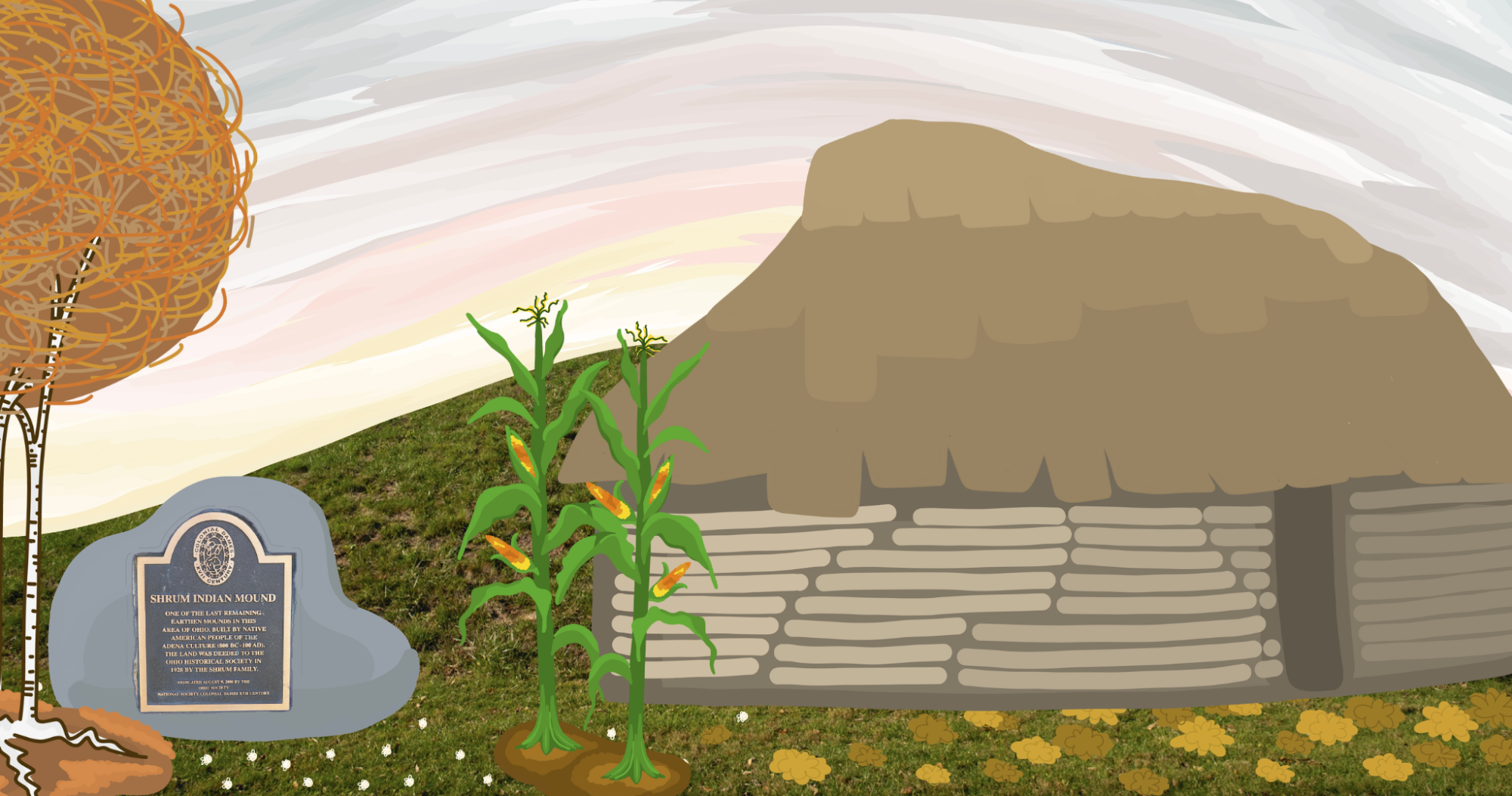
Natives built mounds that were used as worship areas and created sports, such as lacrosse, that are still played today. European settlers had to use many of the techniques Native Americans developed in hunting, gathering and farming in order to stay alive on the unfamiliar land.
TRUE HISTORY OF THANKSGIVING
Every student in UA knows the story of Thanksgiving – it has been told to them again and again from elementary school on up. But much of this story of welcoming and cooperation is a myth, one that obscures the true complex history of Thanksgiving and the real history of Indigenous peoples in the Americas.
The story of Thanksgiving, as told in elementary schools’ social studies classrooms and Thanksgiving pageants, is that pilgrims arriving in the New World struggled to find and grow enough food. They were then aided by a Native tribe which showed them how to grow food in a new environment. The pilgrims and the Native Americans then sat down to a massive, several day long feast where they celebrated their friendship. This version of events is routinely presented as fact, and is what most Americans think of as the first Thanksgiving. But the true version of events is much more complicated and is often seen as brushing off the nuanced history of Native Americans.
The native tribe in the story of Thanksgiving are the Wampanoag. This tribe had been devastated by European disease, with up to 75% of its people dying. This put the Wampanoag in a much weaker position against other tribes, including an enemy tribe, the Narrangasett, who had not been hit as hard by the disease. The Chief of the Wampanoag saw the pilgrims as potential allies to strengthen his tribe.
Ben Barnes, the current Shawnee tribe leader, explained how the pilgrims were struggling greatly after landing in America, unable to grow crops in the strange environment.
“They brought the crops that they had originally grown back in England and other places in Europe. And when those crops failed, it was Native peoples that taught them how to grow crops that would actually survive here, such as sweet potatoes, [corn, tomatoes,] 60% of the world’s foodstuff come from the Americans,” Barnes said. “That’s kind of how they built that relationship.”
This alliance was facilitated by a member of the Wampanoag who spoke English – Squanto – as Andrew Sawyer, the education outreach specialist of the Myaamia Center at Miami University, explained.
“He could interact with the pilgrims because he had been kidnapped and sold into slavery in Europe, and actually lived in Europe for years and learned to speak English and learned European customs before eventually making his way back to his [homeland] in the U.S. and kind of becoming that emissary with the pilgrims and Europeans,” Sawyer said.
Squanto translated for the Wampanoag and shared indigenous farming methods with the pilgrims, helping to establish an alliance between them. When this harvest was successful in 1621, the pilgrims celebrated by firing their guns in the air, and the Wampanoag showed up thinking they had heard a battle but instead found a celebration. They were then invited to join and together with the pilgrims held the feast that would become known as the first Thanksgiving.
However, it was not actually referred to as a “Thanksgiving” at the time. It was unlike actual Puritan Thanksgiving ceremonies which predated it and were typically sober events meant to give thanks to God, and, occasionally, to celebrate violence against Indigenous peoples. This was particularly true after the alliance between them and the Wampanoag fell apart.
This alliance grew increasingly more strained as time passed due to colonial expansion and the spread of disease which ignited tensions. The situation eventually blew up into King Phillip’s War, a bloody conflict between the British colonists and their Indigenous allies that erupted in 1675, devastating the Wampanoag and shifting power in the region to the colonists.
It would not be until decades later that Thanksgiving would become a true holiday. Days of Thanksgiving were often celebrated in New England as religious holidays, or to mark military victories.
A national day of “Thanksgiving and Praise” was celebrated in December of 1776 after the Americans victory in the Revolutionary War. George Washington also urged Americans to celebrate and give thanks on Nov. 26, 1789. Over time, Thanksgiving became less religious and more about gratitude and togetherness, but how and when it was celebrated varied from state to state. But people began to push to make it a unified national holiday, most notably a woman named Sarah Josepha Hale.
Hale’s best known work is the nursery rhyme “Mary Had A Little Lamb,” although she also wrote novels and was the editor of a magazine. She also worked to make Thanksgiving a national holiday, writing officials to Congress, the White House and every state. She continued this work for decades, from including an entire chapter devoted to the importance of Thanksgiving in her first novel published in 1827 to urging President Abrahamn Lincoln to establish the holiday in 1863. It was that persuasion that was finally successful, as Lincoln was looking to bring together a nation torn apart by the Civil War. He proclaimed that Thanksgiving would be celebrated nationwide on the fourth Thursday of November.
The traditional story of Thanksgiving leaves a lot out, and that erasure of its surrounding history can often feel like a slight to Native Americans, who feel like that uplifting story does not do justice to the wars and injustices that came before and after it. This creates tension as it allows some to ignore the colonial implications of the holiday. Barnes explained how Native Americans grapple with the duality and implications of Thanksgiving.
“A lot of the tribes have a Thanksgiving… That is not uncommon to a lot of Native nations. In fact, I would say it is common that tribal nations come together [as] communities to celebrate and give thanks for the harvest of the year,” Barnes said. “It is a nuanced relationship in that you have some people that they’ll celebrate the traditional American holiday at Thanksgiving, because it celebrates colonization. And again, you have others, the majority, probably, that do celebrate it, because we are also Americans. And we also enjoy coming together as family and giving thanks.”
THE LOSS OF TRADITION
Native American history permeates American history, it is all over the country, and it dates back centuries; including right here in Upper Arlington. Upper Arlington Historical Society Executive Director, Kristin Greenberg, shared evidence of Indigenous peoples found by some of UA’s earliest settlers.
“They were also digging at that time,” Greenberg said. “They found surface pottery, flint [chips, Native] American artifacts.”
Much of the evidence that the Historical Society has of an Indigenous presence in Upper Arlington comes from stories.
“We have something from our very first history book about pies disappearing,” Greenberg said.
“Anna Marie Davidson Drake… She was the last person to have that barn that became part of the Amelito Marillo Barn [and] in this 1976 account we have, she was talking about there being an Indian graveyard [up around the] Lane Road area… So it’s possible that there are scattered Indian graveyards around our community, and we just don’t know.”
Despite the Natives being on the land first, the Europeans came over with weapons and diseases that were proven detrimental to Native society. As America grew as a country, the white people who had moved there wanted to have their own “American” culture, and the way the Natives lived went against the image that they wanted to portray to the rest of the world.
Years before any European had ever been to the Americas, Indigenous peoples had cities, civilizations and advanced buildings. Sarah Winningham, Assistant Site Superintendent of Fort Ancient, Ohio’s oldest state park and the largest hilltop enclosure in North America, described how the sites that people see today were built.
“Too many people have no idea how complex Native American history and civilizations pre-contact were. For our site, these ancestors of today’s tribes spent 500-600 years building this complex. All the while they did not live a fully agricultural or sedentary lifestyle. Prior to building the walls, they cleared all the trees on site and for a large distance around the site and removed the site’s topsoil. They then carried basketful after 30lb basketful of soil from outside the site to build the mound walls here. All of this was done by people without any large central government or large cities or large modern machinery,” Winningham said.
Before the Revolutionary War, when the settlers were just there to start a new life away from the place they came from, the Indigenous peoples and Europeans had at least a semi-friendly relationship.
Upper Arlington AP United States History teacher, Adele Vergis, said that in Ohio the European powers needed the help of the Natives so they would trade and compromise with them.
“[For] the first 150 years of European colonial, or the colonial empires being built, the Ohio tribes were trading with and engaging in diplomacy with the French and British imperial powers.
And a lot of times they would catch animals and sell them to the French because in the context of the Little Ice Age, [they needed fur],” Vergis said.
However after the revolution, the young country of America wanted to expand west, especially to Ohio. But the Native Americans did not want to give up their land, so there were many conflicts between the two parties. Vergis said that immediately after the American victory against Britain they fought the Indigenous tribes and were not as successful.
“Ohio will be one of the first places settled by the American settlers moving west because everyone wants to live there.
There are a handful of battles in the Ohio and Indiana border that are decisive. So, immediately after the American Revolution, American troops are going to lose a couple of battles to Indigenous armies,” she said.
Even with the indigenous military success following the revolutionary war, the American troops had a victory that moved the Indigenous peoples further west, giving the Americans access to Ohio.
“George Washington, our first president, send in a huge army of soldiers to defeat the Indigenous armies [in a battle] called the Battle of Fallen Timbers, That is going to lead to a treaty with Indigenous peoples that opens up most of northern Ohio to your white American settlement,” Vergis said.
Once the Americans had gained power over the Indigenous peoples, they put the Native children in schools that taught them how to be a member of the society that the white people created.
“[One of the most famous schools was] called the Carlisle School in Pennsylvania, whose like motto was, ‘Kill the Indian, save the man,’” Vergis said.
Sarah Liese, a Native American researcher and journalist, said that her grandmother, who was fluent in Navajo, did not teach it fully to her mother because she was taught at these boarding schools.
“She was taught at the boarding school pretty much how to succeed is the way that maybe most Americans might think, you know, be a good English speaker and get a corporate job,” Liese said.
The boarding schools got many children to assimilate, who did not teach their children about Indigenous culture, leaving very few people left who know the stories of their ancestors.
“If [a tribe] only had 55 elders that knew the language and then COVID happens and like that was a really big issue for a lot of smaller tribal nations,” Liese said.
Vergis shared the story of an Indigenous man named Jim Thorpe, who was a very talented football player and went to the Carlisle School. She said that while he attended school there, he lost much of his Native culture by cutting his hair and converting to Christianity, but he was also able to become very successful.
“He will convert to Christianity. He’ll meet an Indigenous woman who has converted to Christianity there. And his story is interesting because it shows both how he thrives through this American culture, but also, in his life, he will be used as kind of like a token of successful Indigenous peoples, but he will often also be denied autonomy in certain ways,” she said.
Since Indigenous people had lived on the land for thousands of years before the Europeans arrived, they knew the land very well and were able to use it to their advantage. Winningham said that they had a very effective way to prevent fires, but the Europeans wanted to do everything their way, which caused forest fires to get much worse.
“One of the reasons we have had such bad fire seasons in certain areas is that Europeans stopped doing the prescribed burnings that Native Americans had been using for generations to prevent a buildup of highly flammable plant materials. Areas like the Great Black Swamp of Ohio were drained and turned into farming landscapes, but now they face flooding and constant fights with drainage issues,” Winningham said.
Even though some traditions have died out over the years, Liese said that the most important part of any culture, the community, is still prevalent for Indigenous people in America.
“I think language being separated from my people, from my community was a really big hindrance for me. I think land is really important, building up that community because without that, without being in the community it’s hard to continue these traditions,” Liese said.
NATIVE AMERICAN EFFORTS TODAY
Something that many Native Americans want to emphasize is the message that they are still existing today and are not a thing of the past. Barnes explained that because of these inaccurate depictions, there are many misconceptions and ignorant notions surrounding Native Americans today.
“In places like the Wakaponeta Schools, where they still portray Indians as wearing a headdress and riding buffaloes. You know, it’s just kind of some of those ridiculous stereotypes that tropes that seem to be pernicious, particularly in places like Ohio,” Barnes said.
Liese also added to the list of popular stereotypes of their cultures, and reiterated that they are just stereotypes.
“There’s also a lot of even worse stereotypes such as drug abuse, substance abuse, alcoholism, suicide, domestic violence. I’m not saying that hasn’t been the lived experience of Indigenous people, but it’s not for everyone,” she said.
These historic representations that Ohio pushes are not the full picture, and may mislead people into viewing Indigenous people inaccurately.
“There’s a little bit of disconnect in those communities where they don’t understand that Native communities are alive and doing well,” Barnes said.
Many of the tribes are still alive and persisting through a variety of efforts, one of which Liese mentions as being returning to their homelands they were forcefully removed from.
“I know that a couple of [the native Ohio tribes] are trying to reestablish their relationship with the area,” she said.
Liese explained the implications of these efforts and how vital the connection to land is for the Indigenous peoples.
“You think about how integral land is to Indigenous folks, they had really deep connections with the land because it cared for them and they cared for it back,” she said.
She highlighted what their connection to the land really means with not only their familiarity with the geography, but also their relationship with the water sources, types of food and the animals in their original regions as well. Liese stresses how detrimental their forced removal was.
“Leaving what you know, the land that you know, toppled with having to leave behind who you are, your way of life, your way of speaking, your way of just being in the world is completely decimated, that has a lot of implications,” Liese said.
Another way that Indigenous people are working to protect their culture and communities is through the revival of their language and traditions.
“I think it’s amazing, considering all the efforts that forced assimilation that the U.S. was pushing on Native people, we’ve really seen an amazing revitalization in these communities,” Sawyer said.
He describes the experience of the Miami tribe and their journey to rejuvenating their culture. The Miami children were not allowed to speak their native language while they attended the Indian assimilation boarding schools, so the tribal leaders started to recognize that their language was slowly dying out and being replaced by English.
“In 1990, tribal citizens decided, you know what? No, we want to relearn our language. As they set out to do that, they found an amazing treasure: the archived documents that pretty intensely documented the language,” Sawyer said.
These documents helped the Miami tribe reinforce their identity and revive their language, as well as other cultural traditions like social dances and art forms.
“A lot of their traditional cultural practices were forced to cease entirely, or were just kind of forced underground where people were continuing to practice these things kind of out of the light,” Sawyer said.
These recordings showed that the tribes have always fought to protect their cultures despite the pressure they actively faced from the U.S. government.
Alongside the tribes’ work, there are also many things that they believe would aid their efforts that the state of Ohio could implement. The general consensus has been that Ohio falls short compared to other states when it comes to recognizing Indigenous people.
While their presence is known and recognized to most, the Indigenous peoples widely feel that many do not honestly know them. The Ohio Department of Education places the learning standards in a broader social studies curriculum focused on national narratives rather than in-depth Indigenous perspectives, unlike other historic nations, like the ancient Romans or Greeks who have whole units integrated into the curriculum. Junior Sophia Edwards, a former Wickliff Elementary school student, recalled what she learned about Native Americans.
“We went to the Adena Indian burial ground,” Edwards said. “From there we learned about the tribes that were there in the customs and traditions that they had.”
However, junior Riley DuPont, former Greensview elementary school student, recalled a different experience.
“We learned about the Mayflower and the pilgrims, other than that we didn’t talk about it a lot or go in detail about the history,” DuPont said.
“In total, K through 12, Ohio has like six academic content standards that relate to Indigenous people. Which isn’t much. I mean, it’s next to nothing, and most of that is really in fourth grade,” Sawyer said. “Even when they do that, they’re only talking about Native peoples in the past tense. They’re talking about archaeology, they are talking about sites 13,000 years old or older, and they’re not talking about the fact that Indigenous people are still around today.”
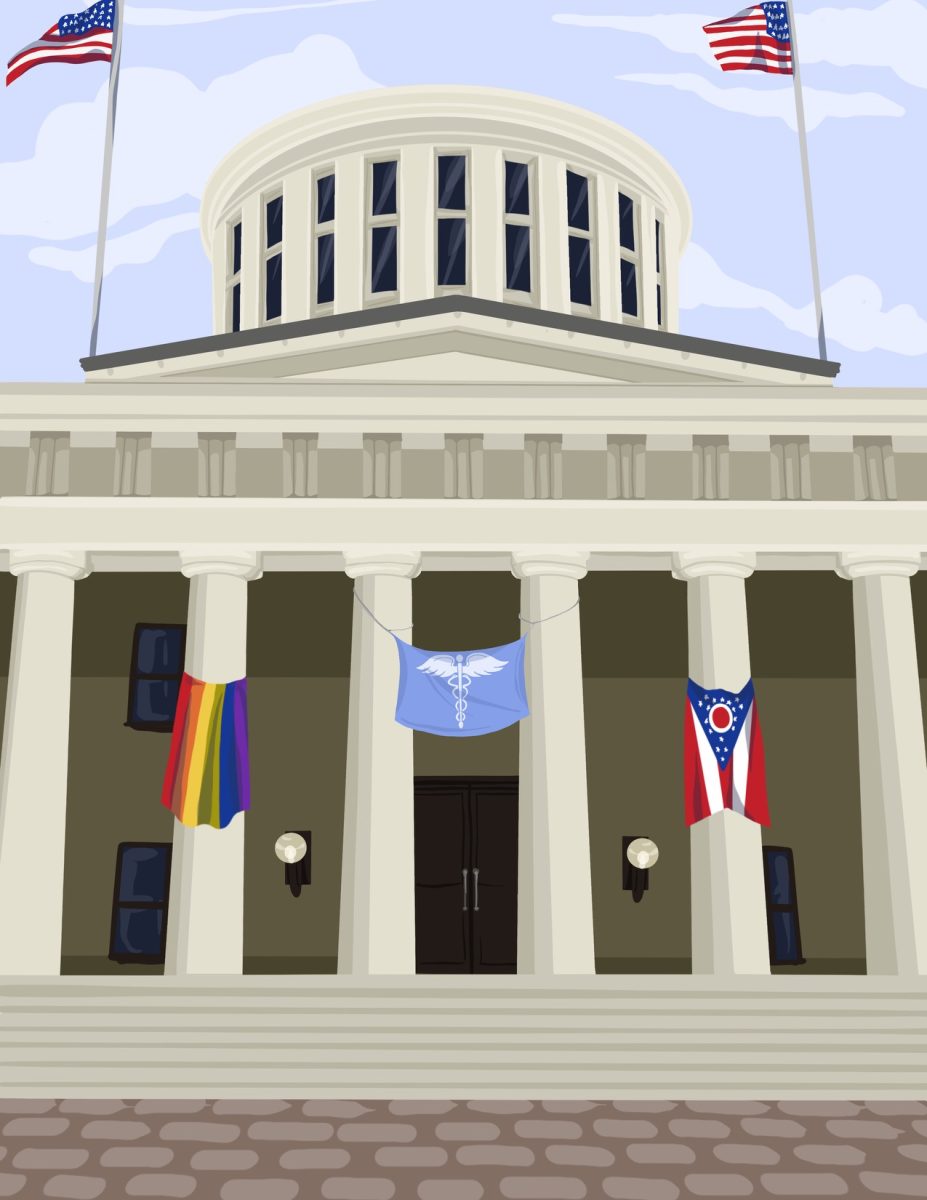
Currently in Ohio there are zero federally recognized Native American tribes, compared to our bordering state just north, Michigan, with 12 federally acknowledged tribes. Major tribes that went through Ohio were the Shawnee, Delaware, Wyandot and Miami. Ohio’s name comes from the Ohio River, named by the Native American tribe, the Seneca. “Ohiyo” means “good river.” Even though the Indigenous peoples think most don’t make an effort, some organizations are more active in including Indigenous groups in their work.
“Generally, the state as a whole does a terrible job of engagement with tribal nations. You do have some outliers, like the Ohio History Connection,” Barnes said. “They do a tremendous job of including tribal voices at events every year we meet with them.”
One way to make people understand Indigenous culture is through implementing more schooling.
“It starts with the education system improving content standards and making sure folks are aware of the actual history of Ohio, and it does not just start with the arrival of European settlers. That it goes back millennia earlier than that,” Sawyer said.
When making a curriculum, the way this information can be most accurate is through the direct source, working with the people.
“At the University of Illinois and the University of Indiana, we’re meeting with chancellor, vice chancellors, provosts and vice provosts and at [The] Ohio State University, their relationship we have with adjunct professors,” Barnes said. “In other states, it’s already happened. But for some reason, Ohio State can’t get any traction.”
…
The path to true recognition of Native Americans in Ohio starts with updating the current curriculum and implementing more Indigenous voices throughout. Positive change, will result in progress throughout recognition.